Whisky vs Brandy: What Is the Difference? A Complete Guide
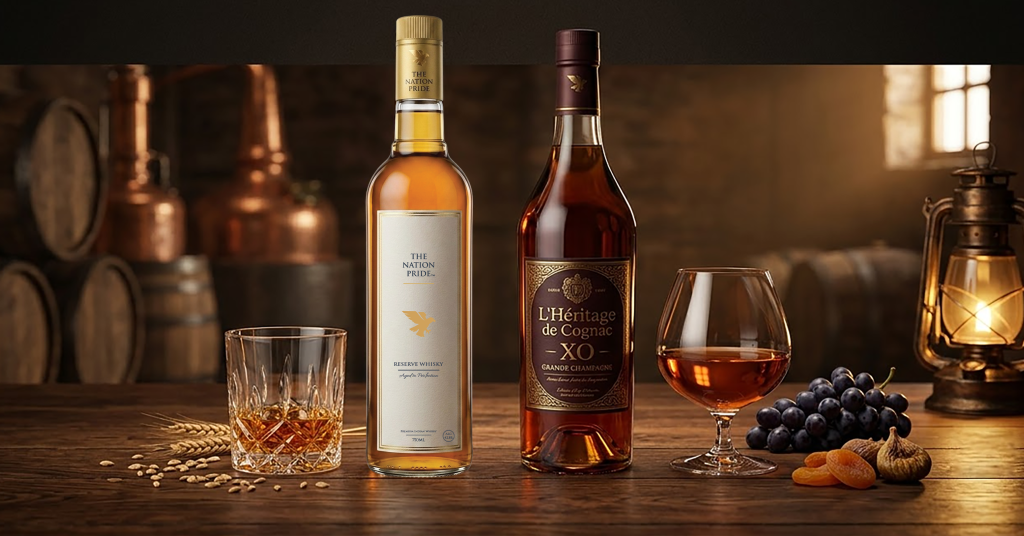
The key distinction between whisky vs brandy is the composition of their raw materials. Producers make whisky from fermented grain mash, while they make brandy from fermented wine or other fruit products. Despite belonging to the distilled spirits group, there are significant differences in the manufacturing process, flavor, aroma, and maturation of these drinks.
What is more, these distinctions affect the process of acquiring the flavor. For example, whiskies may contain flavors of grain, spices, vanilla, caramel, or smokiness, depending on the ingredients and the process of making them. On the other hand, brands usually have such flavors as fruity, floral, dried fruit, or oak.
At the same time, no spirit is characterized by the only flavor profile. A manufacturer’s ingredients, distillation method, and maturation process determine the final flavour. It can help to understand the distinctions between whisky vs brandy better.
In this article, we will discuss what the difference is between whisky vs brandy, their ingredients and production process, alcohol content, and features of The Nation Pride Whisky.
What Is Whisky?
Producers distil fermented grain mash to make whisky. Depending on the style, producers may use malted barley, corn, rye, wheat or other legally permitted grains. Moreover, fermentation and distillation contribute to the development of unique aroma and flavor of the beverage.
As a result, the beverage acquires new colors, aromas, and flavors because of interactions between spirits and wood. For instance, there might be notes of vanilla, caramel, toasted oak, spices, and even smoke.
Moreover, different countries have different traditions of producing the beverage. Thus, Scotch whisky, Irish whiskey, American bourbon, and Indian whisky might differ in terms of the ingredients used, distillation, aging, and blending.
However, it should be mentioned that not all kinds of whisky have a smoky flavor and powerful taste. On the contrary, there are fruity variants of this beverage, as well as the ones that have oak, spice, or malt flavors.
What Is Brandy?
Producers usually make brandy by distilling fermented fruit juice, fruit mash, or wine. Most brandies are made from grapes as the primary raw material. But there are fruit brandies that could be made from apples, pears, cherries, and other fruits.
Initially, fermentation takes place where the natural sugar present in the fruit turns to alcohol. During distillation, producers concentrate the alcohol and selected aromatic compounds. At times, the maturation process is conducted in wooden barrels.
For example, grape brandies that have been aged have aromas of dried fruits, raisins, vanilla, spices, and wood. On the other hand, fruit brandies still have the aroma of the fruit used in its production.
Cognac and Armagnac are some of the grape brandies that originate from certain regions of France and their own production standards. Not all brandies are cognac and armagnac.
Overall, brandy has a lot of varieties. The flavor is a function of fruit, fermentation, distillation, maturation, and production processes allowed for each category.
Whisky and Brandy – What Are the Main Differences?
The first and foremost difference between the two beverages lies in the composition of their raw material.
Moreover, there could be differences in their taste, manufacturing process, and aging process. The following table highlights the main differences.
| Feature | Whisky | Brandy |
|---|
| Main raw material | Fermented grain mash | Fermented fruit products, commonly grapes |
| Production | Fermentation followed by distillation | Fermentation followed by distillation |
| Common flavor notes | Grain, malt, spice, vanilla, caramel, or smoke | Fruit, floral, dried fruit, spice, or oak |
| Color | Clear before maturation; often amber after cask aging | Clear before maturation; often amber after cask aging |
| Maturation | Depends on the whisky category and applicable rules | Depends on the brandy style and production method |
| Recognized styles | Scotch, bourbon, Irish whiskey, and Indian whisky | Cognac, Armagnac, and other grape or fruit brandies |
| Alcohol content | Varies by product | Varies by product |
While these drinks are definitely different, they still have certain similarities as well. Both require fermentation and distillation processes and may age in wooden barrels. Therefore, the only correct way to compare them is to look at their labels.
Whisky vs Brandy: What Makes Their Ingredients Different?
Ingredients form the basis of distinction between these drinks. The raw materials determine the compounds formed after fermentation and distillation.
Ingredients of whisky
Whisky producers commonly use grains such as barley, corn, rye, or wheat. They prepare the mixture of grain and ferment its starch into sugars. These sugars get transformed into alcohol by yeast.
Moreover, the choice of grains also determines the taste of whisky. For instance, malted barley provides cereal notes, while some types of rye whiskies contain spice.
The ingredients found in Brandy
Brandy producers usually start with grapes, wine, or other fruit products. The fruit supplies fermentable sugars and aromatic compounds that influence the brandy’s flavour.
Thus, the brandy could have fruit-related characteristics as well as the characteristics developed during the process of distillation and aging. However, not all types are alike; hence, one cannot expect all types of brandy to have a fruity taste.
In summary, whisky is produced from grains, whereas brandy is made from fruits.
How is Whisky Made?
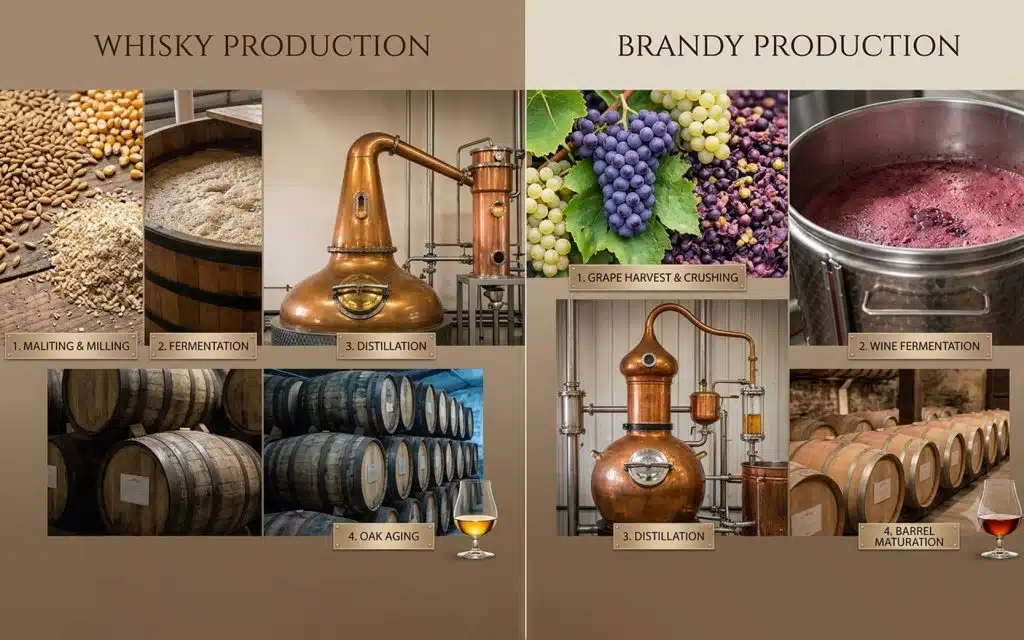
The production of whisky consists of a number of interrelated processes. Each process affects the nature of the whisky.
Step 1: Grain Preparation
For certain whisky styles, producers malt the barley and then grind the grains before fermentation.
Step 2: Mashing
During this process, producers combine prepared grain with water to release fermentable sugars.
Step 3: Fermentation
As a result, the yeast converts the sugar into alcohol and produces the components creating the smell. The conditions of fermentation and selection of yeast influence the produced liquid.
Step 4: Distillation
The last step involves distillation of the liquid.
During this process, distillation separates and concentrates alcohol and selected flavour compounds.
Step 5: Aging and blending
Producers can mature whisky in wooden casks when its category requires or permits this process. It will receive additional color, aroma, and taste at this stage. Finally, the producers can blend the chosen spirits and make necessary corrections according to the specification.
However, there is a difference in production depending on the type of whisky and the country.
How Is Brandy Produced?
The procedure for producing brandy is somewhat similar, though it differs from the base used for producing this spirit.
Step 1: Selection of fruits
In the first step, the fruit is selected; it is generally grapes.
The fruit’s quality influences the characteristics of the fermentation.
Step 2: Fermentation
In the second step, yeast turns sugar in the fruit into alcohol. Generally, grape brandy involves the fermentation process applied to wine.
Step 3: Distillation
Producers distil the fermented liquid to concentrate alcohol and selected aromatic compounds. The method used for distillation will affect the final characteristics of the beverage.
Step 4: Maturation
Certain brandies age in wooden barrels. Through the process of maturation, the brandy obtains deeper color and woody aromas and gets more aromatic. Nevertheless, certain brandies can be stored in some other way.
Step 5: Blending and Bottling
Finally, producers may blend specific spirits to have uniform characteristics. They will then package their product following the appropriate production guidelines.
Fruit selection, distillation, and aging will thus play a part in the unique nature of brandy. However, the production process varies from one type of brandy to another.
In the first step, the fruit is selected; it is generally grapes. Depending on the quality of the fruit used, the fermented base will vary accordingly.
Which Drink Is Bolder in Taste—Whisky or Brandy?
The question regarding the taste cannot be answered unambiguously, because it varies depending on particular items and their peculiarities noticed by a consumer.
In the case of whisky, its flavors include those of cereal, malt, pepper, vanilla, caramel, toasted oak, and smoke. As an example, Peated whiskies often feature strong smoky flavours, while other varieties display malty or fruity notes.
Brandy usually has a grape, dried fruits, flowers, spices, and oak. Moreover,
Nevertheless, there is no relationship between flavor intensity and alcohol strength. It means that one drink can be characterized by a strong aroma but not necessarily contain more alcohol than another one.
Thus, customers should consider particular products instead of making an assumption about the bolder flavor of one drink.
Differences in Colour between Whisky and Brandy
Colour is important when describing the spirit, but it cannot be used for its classification or as a measure of its quality.
Both newly distilled whisky and brandy can have clear colours. In course of ageing, however, due to contact with wooden barrels, these spirits can receive amber, gold or brown shades.
Thus, for instance, matured whisky in the right oak barrel might have golden or dark amber shade. Also, matured brandy can have the same colour due to its maturing.
Nonetheless, colour depends on the distillation process, maturation process and colouring possibilities. There might also be other processes involved which affect the colour of the drink.
So, dark-coloured spirit does not mean it is necessarily more mature, more qualitative or stronger. It is better to pay attention to the information on the label.
Comparison Between Whisky Vs Brandy In Terms Of Alcohol Content
The alcohol content may be different between one bottle and another. Hence, neither whisky nor brandy will automatically contain a higher amount of alcohol.
In general, manufacturers mention the amount of alcohol present in any particular spirit in terms of alcohol by volume (ABV). This shows the amount of pure alcohol in any particular spirit.
For instance, the ABV value of 40% means that there is 40 milliliters of pure alcohol in 100 milliliters of the particular spirit.
In India, the strengths of various products may vary according to brands. Hence, the best way of comparing two spirits would be reading their ABV value.
Furthermore, a high ABV value does not imply anything about the taste of the particular product. It just reflects the presence of a high amount of alcohol.
Whisky Vs Brandy—Which Is Better?
No spirit wins across the board when we talk about whether whisky is better than brandy. They both have something unique to offer. The choice should be based on preferences, not the quality rating.
Whisky may appeal to those who are interested in learning more about grain spirits, maltiness, the influence of oak, etc., whereas brandy will allow you to look into fruit spirits and aromas that develop in them due to the use of grape or any other fruit material.
Price, brand reputation, product information, and taste are also the factors that affect people’s choice of a particular bottle of spirits. But a high price tag does not mean that the spirit will always be better.
When comparing spirits, take a look at the product label, alcohol content, category, ingredient list and manufacturer. Most importantly, do not make generalizations about which spirit is always smoother and stronger.
The Nation Pride Whisky
The official website describes the product as a whisky brand with bold taste.
As a whisky, The Nation Pride falls into the category of whisky, as opposed to brandy, where its main distinguishing feature is the use of fermented fruit products as an initial substance.
Finally, those who wish to compare The Nation Pride with a brandy need to pay attention to the particularities of each product mentioned in the provided information. Do not think that all whisky and brandy bottles have the same qualities.
To know more about the brand, visit the official website: The Nation Pride Whisky.
Consequently, the most important information is contained in the product comparison. The Nation Pride Whisky is a good example in this case.
Frequently Asked Questions About Whisky vs Brandy
Q1. What is the distinction between whisky vs brandy?
The main point of distinction is that different ingredients are used to produce both drinks. For example, producers make whisky from fermented grains, whereas they make brandy from fermented fruit products or wine. Nevertheless, whisky and brandy are not distinguished from each other only because of the ingredients but also because of their taste and smell.
Q2. Which drink is more powerful, whisky vs brandy?
It depends on the specific product, because the content of alcohol may vary depending on it; thus, it is necessary to see the percentage of alcohol in the bottle. ABV is the acronym for alcohol by volume and shows how much alcohol the alcoholic beverages contain.
Q3. Does whisky contain grain, and does brandy contain fruit?
In general, the answer is yes. Producers use grain to make whisky and fermented fruit products to make brandy.
Q4. What makes whisky vs brandy differ in colour?
Both can get their coloring while maturing in wood barrels. But the colour is determined not only by their maturation process but also by the way they are produced and how they are colored. Thus, colour does not determine the age and quality of any spirit.
Q5. Is The Nation Pride whisky or brandy?
The Nation Pride is a whisky from the Grihy Beverages Private Limited company. Thus, it is not a brandy but a whisky.
Conclusion: Distinctions Between Whisky and Brandy
The main distinction between whisky and brandy is that producers make whisky from fermented grain mash and brandy from fermented fruit products. Both products go through fermentation and distillation; different raw materials and methods influence the taste of the drinks.
Alcohol content, dark color, and intense taste do not make either whisky or brandy superior to the other drink. Everything depends on the specific product and its production.
Those who are curious about Indian whisky brands should pay attention to such a product as The Nation Pride Whisky, which Grihy Beverages Private Limited manufactures.
Drink responsibly: The consumption of alcohol products can have negative impacts on a person’s health. Follow the drinking age rules and laws. Don’t drink and drive.