Type of Whisky: A Complete Guide to Different Whisky Styles
The world of whisky is very diverse when it comes to flavor profiles, aroma, ways of production, and styles. That is why it is important to know about different type of whisky, and it will help you choose bottles that fit your taste perfectly. Besides, different styles of whiskies may differ because of various grains used, ways of production, aging, and other factors.
For those who start studying the whisky world, the variety of terms used may be confusing. However, it is unnecessary for you to learn all of them before starting to enjoy different whiskies.
In this guide, we will discuss the most popular types of whiskies such as blended whisky, single malt whisky, grain whisky, Scotch whisky, Irish whiskey, bourbon, and rye whiskey. We will also explain the peculiarities of each type to help you understand the category.
What Are the Various Type of Whisky?
Whisky refers to various kinds of whisky that differ in ingredients, manufacturing process, source, and legislation. Thus, single malt whisky relies mainly on malted barley and manufacture at a single distillery, whereas blended whisky is a mixture of various type of whisky.
Bourbon and rye whiskey fall under the category of American whiskeys, but Scottish distillers make Scotch whisky in Scotland. In contrast, Irish distillers produce Irish whiskey according to unique manufacturing rules.
Therefore, there are numerous varieties of whisky existing today. Consequently, being aware of the key distinctions between them is highly useful when buying bottles of whisky.
Classification of Various Type of Whisky
Experts use several criteria to classify various types of whisky. Firstly, experts classify whisky according to the grains used. Secondly, The production process also helps experts distinguish between different whisky types. Lastly, geography and local laws can serve as a basis for classification of whisky.
As an example, Scotch whisky has five legal classifications such as Single Malt, Single Grain, Blended Scotch, Blended Malt, and Blended Grain.
It means that the term “types of whisky” is not connected with a particular classification system but rather represents a variety of whisky types.
Blended Whisky Definition
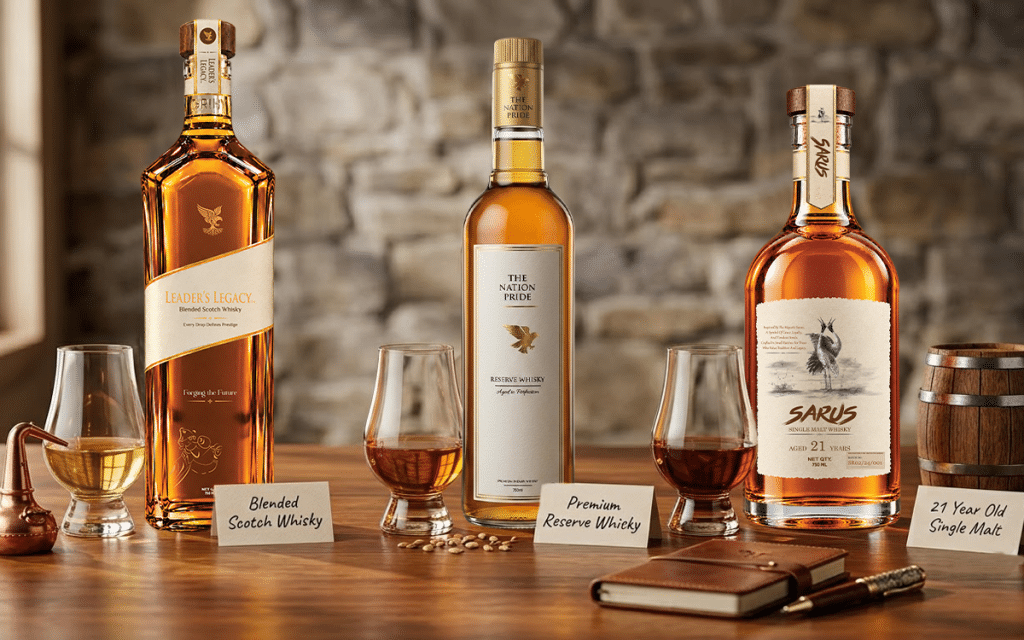
Blenders make blended whiskies using different whiskies. Blenders usually combine both malt whisky and grain whisky in blends. Hence, the blender is able to combine all necessary elements and make the drink with a desirable taste.
Moreover, the use of blending helps to maintain consistency between the batches of whisky. That is why blending is one of the most popular techniques in the whisky market worldwide.
Besides, blending can be interesting for those who are trying whisky for the first time. Nonetheless, the choice is always individual, and every person will prefer a particular taste and aroma.
What Makes Blended Whisky One of the Popular Types of Whisky?
When we talk about blended whiskies, we have to consider that blending includes the use of different elements of whisky. That is why the drink will have a balance of tastes.
Moreover, the importance of the blender becomes clear since his work will depend on the proportions of whiskies and their elements. Hence, it is possible to distinguish two blends within the same category.
Why Is Single Malt Whisky a Popular Type of Whisky?
A single distillery makes single malt whisky from malted barley. With regard to single malt Scotch whisky, the definition requires one distillery to use water and malted barley and batch-distill the whisky in copper pot stills.
Hence, the term “single” means single distillery and not single cask or single year.
Also, the distillery, distillation method, maturation process, and environment can shape the qualities of single malt whisky.. Consequently, various single malts can have very different taste profiles.
Why Do People Like Single Malt Whisky?
Single malt whisky remains popular because every distillery can develop its own style. Thus, production and maturation processes can affect the taste, smell, body, and finish of the whisky.
Nevertheless, a single malt whisky may not please every consumer.
What Is Grain Whisky and Where Does It Fit Among Types of Whisky?
As the name suggests, producers make grain whisky from grains besides or along with malted barley based on the classification or production criteria. The example includes other cereals such as wheat or maize.
Most producers use the continuous distillation method for grain whisky. This allows grain whisky to have light qualities and serve as an element in blended whiskies.
Furthermore, producers may bottle some grain whiskies for individual consumption. Consequently, the issue should be considered while discussing various types of whisky.
What is blended scotch whisky?
Blenders combine one or more single malt Scotch whiskies with one or more single-grain Scotch whiskies to create blended Scotch whisky. Scotch whisky regulations define this category.
Thus, blended Scotch unites malt and grain whisky. In this case, a blender is able to achieve a certain balance of flavor and character.
Scotch whisky regulations set specific production requirements. Producers must distill and mature Scotch whisky in Scotland for at least 3 years and bottle it at not less than 40% ABV.
What is blended malt whisky?
Blenders combine two or more single malt whiskies from different distilleries to create blended malt whisky. Blended malt whisky differs from blended Scotch because it contains no grain whisky.
Thus, blended malt and blended Scotch should not be considered one type of whisky.
In addition, the blending of several single malts enables manufacturers to unite features of different distilleries. Thus, the whisky gets a unique profile.
What Is Irish Whiskey?
Irish whiskey is a whiskey variety produced in Ireland. Normally, Irish whiskey may include many varieties, like single malt, grain, blend, and single pot still Irish whiskey.
Also, Different Irish whiskey styles may use either malted or unmalted grains. For instance, Irish Single Pot Still Whiskey is a whiskey variety that contains malted and unmalted cereals and has particular production standards.
Thus, Irish whiskey becomes another significant whiskey variety for the global whiskies’ and whiskeys’ world.
What Is Bourbon Whiskey?
Bourbon whiskey is an American whiskey that follows specific production standards. For instance, Bourbon producers must use a mash bill containing at least 51% corn. Moreover, Bourbon producers usually age bourbon whiskey in new charred oak barrels according to U.S. requirements.
So, bourbon whiskey may develop certain features due to its unique grain composition and oak aging.
Still, bourbon and Scotch whisky are two separate concepts.
What Is Rye Whiskey?
In addition to Bourbon and Tennessee whiskey, there is another American whiskey style, which is rye whiskey. American regulations require rye whiskey to contain at least 51% rye.
Since rye gives whiskey the distinct grain flavor, rye whiskey can become spicy. Nevertheless, the taste will depend on the recipe, distillation, aging, and other factors.
As a result, rye whiskey is a good option for individuals looking for something more than blended or malt whisky.
What Are the Types of Indian Whisky?
There are several whisky types, and Indian whiskies are among them. In India, there are not only blended whiskies but also Indian single malts.
Furthermore, since the weather conditions are different, the whisky may age differently and take unique characteristics. As a result, Indian whiskies should be considered by those interested in learning about the different types of whiskies.
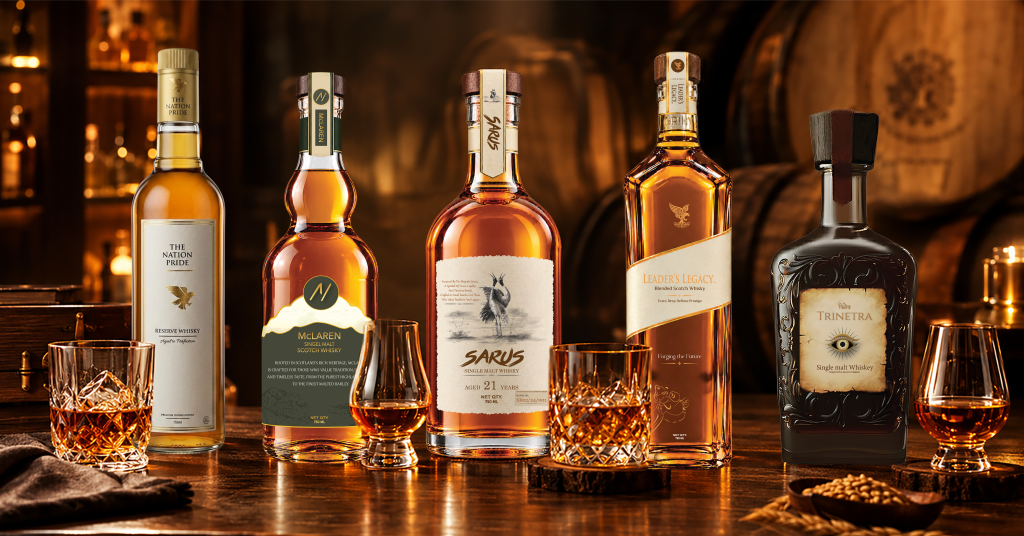
Besides, Indian single malts, there are also brands of blended Indian whisky, one of them being The Nation Pride Whisky
Type of Whisky According to Production Style
In the consideration of types of whiskies, production style may help understand why they differ from one another.
- Blended Whisky
The blending of whiskies consists of combining various elements of the drink. Consequently, it is possible to achieve balance and consistency.
- Single Malt Whisky
The term “single malt whisky” indicates that the whisky is made in a single distillery using the required amount of malted barley.
- Grain Whisky
Producers use cereal grains to make grain whisky. It adds light flavoring to the blend. Additionally, certain types of grain whisky can be bottled separately.
- Blended Malt Whisky
This sentence is already active, so no change is needed. It does not contain grain whisky like blended Scotch.
How Do Different Types of Whisky Taste?
Different whisky varieties can offer diverse taste profiles. First, whiskies with emphasis on malts will have complex tastes. However, grain whiskies can have light tastes.
Moreover, blended whiskies will also have different mixes of tastes, and bourbons will have strong tastes of oak and sweet grains. But the rye whiskies will have spicy tastes.
However, the above is just one sample of descriptions since there can be different factors that influence the taste. Several factors influence the taste, including maturation, casks, production processes, mixing, and bottling.
Hence, it is wise to test the different variants of whiskies in order to find out their tastes.
Various Type of Whisky for Newbies
Should you be new to whisky, you may begin your adventure by exploring the basic types. Firstly, learn about the difference between blended and single malt whiskies. Secondly, get to know grain and blended malt whiskies. Finally, find out about Scotch, Irish whiskey, bourbon, rye and Indian whisky.
Also, beginners can compare aroma, taste, body, finish and service method. For instance, taste a little of the drink straight before watering or chilling it. Observe the change in both aroma and taste.
In the end, it all depends on your own preferences.
How to Choose the Right Type of Whisky
Choosing the right whisky would become simple for you if you consider certain key points to start with. Firstly, it would be important for you to know the type of whisky you have chosen. Moreover, you should know how the whisky is described on its bottle and how it is produced.
In addition, one should consider such aspects as taste, alcohol content, size of the bottle, an occasion, and price of the drink.
A balanced whisky would be a perfect choice for beginners. However, people who already know about the whisky may prefer a rich, strong, or unique one.
Thus, rather than choosing popular whisky, one needs to know what he or she really wants in a drink.
Blended Whisky vs Single Malt Whisky
Blended whisky and single malt whisky differ mainly in their production categories. Generally, blended whisky combines different whiskies, while single malt whisky comes from one distillery and uses malted barley according to the applicable rules.
| Feature | Blended Whisky | Single Malt Whisky |
|---|---|---|
| Production | Combines different whiskies | Produced at one distillery |
| Main grain | Can include malt and grain whisky | Malted barley |
| Character | Can focus on balance and consistency | Often reflects individual distillery character |
| Variety | Many blending combinations | Different distillery styles |
| Suitable for | Various drinking preferences | Whisky exploration and enthusiasts |
However, this comparison does not mean that one category is universally better. Instead, each style offers a different experience.
What is the difference between whisky and whiskey?
Sometimes one may encounter both “whisky” and “whiskey” on the bottle labels. Typically, “whisky” is used for Scotch whisky and a variety of other countries, whereas “whiskey” is used by American and Irish companies.
Still, it would not give you the complete information about the alcoholic drink. Actually, origin, regulations, ingredients, maturing process, and types should be taken into account to learn more about it.
Thus, if one wants to compare various types of whisky, it is important to keep in mind the origin and type of whisky.
Why Should You Know About Different Kinds of Whisky?
Knowing the types of whisky can make your shopping and tasting easier. Firstly, it can help you understand the labels of bottles. Secondly, it can give you an idea of the production process. Thirdly, it will allow you to compare different bottles.
Additionally, it can help beginners avoid the confusion with types of whisky. For instance, the knowledge of the differences between single malt, blended malt, and blended Scotch makes whisky labels much clearer.
Thus, understanding the basic kinds of whisky will make your whisky experience more interesting and educational.
Frequently Asked Questions About Type of Whisky
Q1. What Are the Main Type of Whisky?
Different whisky categories include blended whisky, single malt whisky, grain whisky, blended malt whisky, Scotch whisky, Irish whiskey, bourbon, rye whiskey, and others. Nonetheless, definitions of the specific whiskies vary from country to country.
Q2. Which Type of Whisky Is Suitable for Beginners?
A beginner should not be limited to just one kind of whisky. Rather, he or she can try different kinds depending on personal preferences.
Q3. How Does Blended Whisky Differ from Single Malt?
In blending, whiskies are mixed. On the contrary, single malt whisky is made in one distillery using malted barley in compliance with production regulations. Thus, there exist differences between these two types of whiskies both in terms of production and quality.
Q4. Is Single Malt Whisky Better than Blended Whisky?
This statement is rather debatable. In fact, single malt and blended whiskies have some distinguishing features.
Q5. What are the types of Scotch whisky?
Scotch Whisky comes in five types: Single Malt, Single Grain, Blended Scotch, Blended Malt, and Blended Grain.
Q6. What is the difference between whisky and Whiskey?
The main difference lies in the spelling of the drink depending on the country where it’s made. For example, Scotch is spelled as “whisky,” whereas Irish and American tend to spell it as “whiskey.
Q7. What Should a Beginner Seek While Selecting a Whisky?
Beginner whisky drinkers can rely on factors like the type of the drink, its taste, the alcohol percentage, the size of the bottle, cost, and drinking preferences.
Conclusion
There are a lot of different types of whisky. These can be blended single malt, grain, Scotch, Irish whiskey, bourbon, rye and Indian whisky. Each type is unique and offers its distinctive features.
At the same time, knowledge of various types of whisky allows you to better understand label information and discover new tastes. However, one type will not be suitable for all people.
Hence, choose a type of whisky according to your tastes and experience other types gradually. By tasting different kinds of whisky responsibly, you can learn more about the aroma, taste, finish, and production method of the whisky.
Last but not least, remember about responsible drinking and compliance with the drinking age limit.