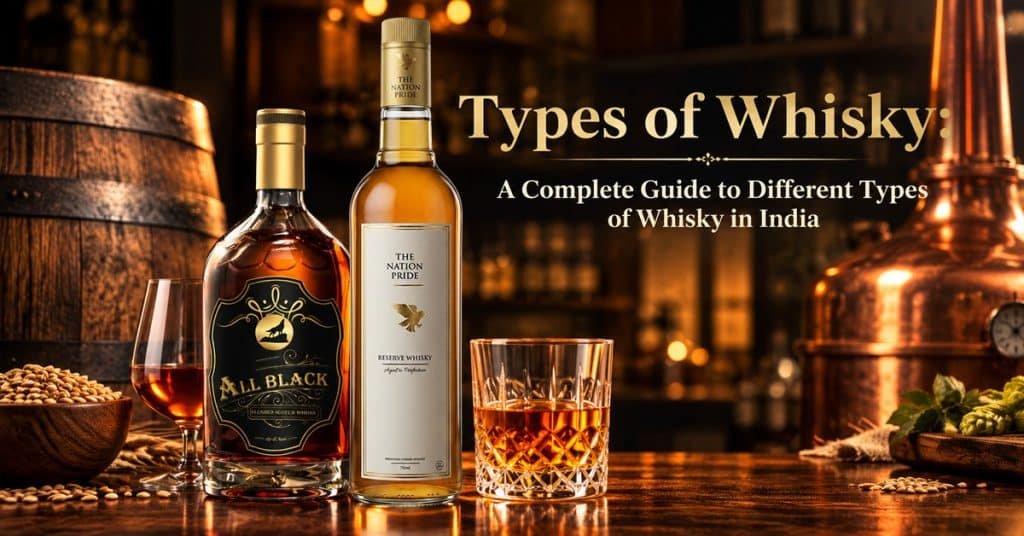
Types of Whisky: A Complete Guide to Different Types of Whisky in India
Whisky is one of the most consumed spirits in the world. However, choosing a particular bottle can feel difficult when you come across terms such as “single malt,” “blended,” “grain,” “Scotch,” “bourbon,” and “Indian whisky.” Each category follows its own production process, uses different ingredients, and can offer a distinct drinking experience.
Understanding the types of whisky makes it easier to read bottle labels, compare different styles, and discover flavours that match your preferences. Moreover, learning about whisky categories helps beginners understand why two bottles can taste very different even when both contain whisky.
In this guide, we explore the major types of whisky, explain their key differences, and discuss popular whisky varieties available in India and around the world.
What Is Whisky?
Whisky is a distilled alcoholic beverage made from fermented grains and usually matured in wooden barrels. However, ingredients, production techniques, distillation methods, and maturation practices can vary according to the whisky style and country of origin.
Common grains used to produce whisky include malted barley, corn, wheat, and rye. Distillers select and process these grains according to the flavour and character they want to achieve.
Whisky production usually involves several important stages:
- Grain selection and preparation
- Mashing
- Fermentation
- Distillation
- Maturation
- Blending, where applicable
- Bottling
Each stage can influence the final spirit’s aroma, taste, texture, colour, and character. As a result, production choices play an important role in creating different whisky styles.
Furthermore, whisky does not belong to one single category. Different countries and distilleries have developed distinctive production traditions, which have created a wide range of whisky varieties.
Types of Whisky: What Are the Most Common Types?
The types of whisky can differ according to ingredients, production methods, blending practices, and geographical origin. Therefore, understanding these categories can help you make better sense of whisky labels.
Some commonly discussed whisky types include:
- Single Malt Whisky
- Blended Whisky
- Blended Malt Whisky
- Grain Whisky
- Bourbon Whiskey
- Rye Whiskey
- Scotch Whisky
- Irish Whiskey
- Japanese Whisky
- Indian Whisky
These categories can sometimes overlap. For example, Scotch whisky includes single malt, single grain, blended malt, blended grain, and blended Scotch categories.
When comparing different bottles, consider both the whisky’s country of origin and its production method. As a result, you can better understand what makes each whisky style different.
Single Malt Whisky: A Popular Type of Whisky
Single malt whisky remains one of the most recognised types of whisky among enthusiasts. Its distinctive production method gives it a strong connection with the character of its distillery.
A single malt comes from a single distillery and uses malted barley as its primary grain. Importantly, the word “single” refers to the distillery rather than one cask or one batch.
This distinction often causes confusion among beginners. A distillery can combine whisky from several casks and still produce a single malt, provided the whisky meets the relevant category requirements.
Single malt whiskies can offer a broad range of aromas and flavours. Depending on the distillery and production choices, these expressions may feature notes such as:
- Fruit
- Vanilla
- Oak
- Spice
- Caramel
- Dried fruit
- Chocolate
- Smoke or peat
In addition, maturation conditions, cask type, distillation style, and maturation period can influence the final character.
For example, Trinetra Single Malt Whisky provides an Indian example when discussing single malt whisky and its distinctive character.
If you want to compare this style with another major whisky category, explore our guide to single malt vs blended whisky.
Blended Whisky: A Versatile Whisky Type
Blended whisky combines different whiskies to create a specific flavour profile. Depending on the category, a blend can contain malt whisky, grain whisky, or a combination of both.
Blending gives whisky makers greater flexibility when creating a balanced and consistent profile. For instance, producers can combine whiskies with different aromas, flavours, strengths, and maturation characteristics.
Many popular whiskies around the world belong to blended categories. Blended Scotch, for example, combines one or more single malt Scotch whiskies with one or more single grain Scotch whiskies.
As a result, blended whisky can offer a versatile and approachable drinking experience. Many beginners find balanced blends easier to explore when they start their whisky journey.
However, blending does not make a whisky inferior to a single malt. Instead, both styles follow different production approaches and can appeal to different preferences.
Leaders Legacy Blended Whisky can also serve as an example when discussing blended whisky within the Indian whisky market.
Grain Whisky and Blended Malt Whisky Explained
Grain whisky provides another important category within the wider world of types of whisky. Unlike single malt whisky, grain whisky can use grains such as wheat or corn alongside malted barley.
Single grain whisky comes from one distillery, while blended grain whisky combines grain whiskies from multiple distilleries. Generally, grain whisky can provide lighter characteristics and plays an important role in many blends.
Blended malt whisky follows a different approach. Producers combine single malt whiskies from multiple distilleries without adding grain whisky. Therefore, blended malt differs from blended whisky, which can contain both malt and grain whisky.
At first, these terms may seem confusing. Once you understand the meaning of “single,” “blended,” “malt,” and “grain,” whisky labels become much easier to understand.
Scotch, Bourbon, Irish and Japanese Whisky
Country of origin also plays an important role when exploring different types of whisky. Each major whisky-producing region has developed its own traditions, regulations, and production methods.
Scotch Whisky
Scotch whisky comes from Scotland and includes categories such as single malt, single grain, blended malt, blended grain, and blended Scotch.
Regional styles can also influence the character of Scotch. For example, Islay has a strong reputation for smoky and peaty whiskies, while many Speyside expressions feature fruity and sweet characteristics.
Nevertheless, individual distilleries can produce significantly different flavour profiles. Cask selection, maturation, production choices, and blending can all influence the final character.
Bourbon Whisky
Bourbon is an American whiskey style with specific production requirements. Its mash bill must contain at least 51% corn, while producers mature bourbon in new charred oak containers.
Consequently, bourbon often develops flavours such as vanilla, caramel, oak, and spice. These characteristics make it a popular choice for people who enjoy richer and sweeter flavour profiles.
Irish Whisky
Irish whiskey comes from Ireland and includes several different styles. Producers can use both malted and unmalted grains, while some Irish whiskies undergo triple distillation.
As a result, many Irish whiskey expressions offer approachable, smooth, fruity, or creamy characteristics. However, brands can create different flavour profiles through their production methods and styles.
Japanese Whisky
Japanese whisky has gained considerable attention for its focus on balance and precision. Many Japanese producers draw inspiration from traditional Scotch production while developing their own distinctive approach.
Consequently, Japanese whisky can range from light and delicate expressions to richer and more complex styles.
Types of Whisky in India: What Should You Know?
India has a large and diverse whisky market. Consumers can explore Indian blended whiskies, grain-based products, Indian single malts, and whisky styles influenced by international traditions. Climate also influences whisky maturation in India, as warmer conditions can accelerate the interaction between whisky and oak compared with cooler environments. However, consumers should not assume that every bottle labelled “whisky” follows the same production process because Indian regulations recognise different whisky categories and establish requirements for specific styles. For this reason, checking the bottle label and understanding its category can help consumers make more informed choices. Indian single malt has also become an important part of the global whisky conversation. Moreover, India-focused whisky discussions increasingly include Indian single malts alongside Scotch and other international whisky styles.
How to Choose the Right Type of Whisky
Choosing between different types of whisky ultimately depends on your personal preferences. Your experience, preferred flavours, and occasion can all influence the right choice.
If you are new to whisky, a balanced blended whisky can provide an approachable starting point. On the other hand, drinkers who enjoy distinctive flavours and individual distillery character may prefer single malts.
Consider these points when choosing a bottle:
For beginners:
Choose a balanced whisky with approachable flavours that do not overwhelm your palate.
For richer flavours:
Explore single malts with deeper notes of oak, fruit, spice, or smoke.
For lighter profiles:
Consider grain whiskies or lighter blends if you prefer a more delicate character.
For smoky flavours:
Explore peated Scotch styles, particularly whiskies associated with regions such as Islay.
For Indian whisky:
Explore Indian blends and single malts to experience how local conditions, ingredients, distillation, and maturation can influence whisky character.
Most importantly, avoid choosing a whisky solely because it has a higher price. A more expensive bottle may not necessarily match your personal taste.
Types of Whisky: Single Malt vs Blended vs Grain
Comparing the major types of whisky makes it easier to understand their basic differences.
Whisky Type
- Single Malt
- Blended Whisky
- Single Grain
- Blended Malt
- Scotch Whisky
- Bourbon
- Irish Whisky
- Japanese Whisky
- Indian Whisky
Basic Idea
- Malt whisky from one distillery
- Combination of different whisky styles
- Grain whisky from one distillery
- Single malts from multiple distilleries
- Whisky produced in Scotland
- American whisky with at least 51% corn
- Whisky produced in Ireland
- Whisky made in Japan
- Diverse category produced in India
Common Character
- Distinctive and complex
- Balanced and versatile
- Often lighter and delicate
- Rich and varied
- Wide range of regional styles
- Often sweet, rich and oaky
- Often smooth and approachable
- Often precise and balanced
- Varies from blends to single malts
This comparison highlights an important point: no single whisky type suits everyone. Each category offers a different production tradition and flavor experience.
If you want to explore the difference between two of the most popular categories, read our detailed guide on single malt vs blended whisky.
Frequently Asked Questions About Types of Whisky
Q1. What are the main types of whisky?
The main types of whisky include single malt, blended whisky, single grain, blended malt, Scotch, bourbon, Irish whiskey, Japanese whisky, and Indian whisky. However, some categories can overlap because producers classify whisky according to both production methods and geographical origin.
Q2. What is the difference between single malt and blended whisky?
Single malt comes from one distillery and uses malted barley as its defining grain. In contrast, blended whisky combines different whiskies to create a particular flavour profile. Depending on the category, a blend can include both malt and grain whisky.
Q3. Which type of whisky is suitable for beginners?
The right choice depends on personal taste. However, many beginners find balanced blended whiskies approachable because they can offer smooth and well-rounded flavour profiles. Meanwhile, people who want to explore stronger individual characteristics may enjoy single malt whisky
Q4. Is Scotch a type of whisky?
Yes. Scotch whisky is a type of whisky produced in Scotland according to specific production requirements. The Scotch category includes single malt, single grain, blended malt, blended grain, and blended Scotch.
Q5. Is Indian whisky different from Scotch whisky?
Yes. Indian whisky and Scotch whisky follow different production traditions and regulations. Indian whisky includes several categories, while Scotch must meet specific requirements established for whisky produced in Scotland. Therefore, ingredients, production methods, maturation conditions, and flavour profiles can differ.
Final Thoughts on Different Types of Whisky
It definitely becomes easier to get into the world of whiskies when you understand the different kinds. There is the single malt whisky, the blended whisky, the grain whisky, the Scotch whisky, the bourbon, the Irish whiskey, the Japanese whisky, and even the Indian whisky. Every kind has its own production method and unique features.
Moreover, there is no need to believe that one is definitely better than the other. Single malts may suit people who love unique flavors whereas the blend can work well for someone who needs versatility and consistency.
The key to success lies in reading the labels and discovering the kind of whisky that suits your tastes.
Whisky categorization is an easy way to get started as a beginner and an enthusiast of whiskies.