What Is Whisky Made From? Ingredients, Grains & Their Role in Taste
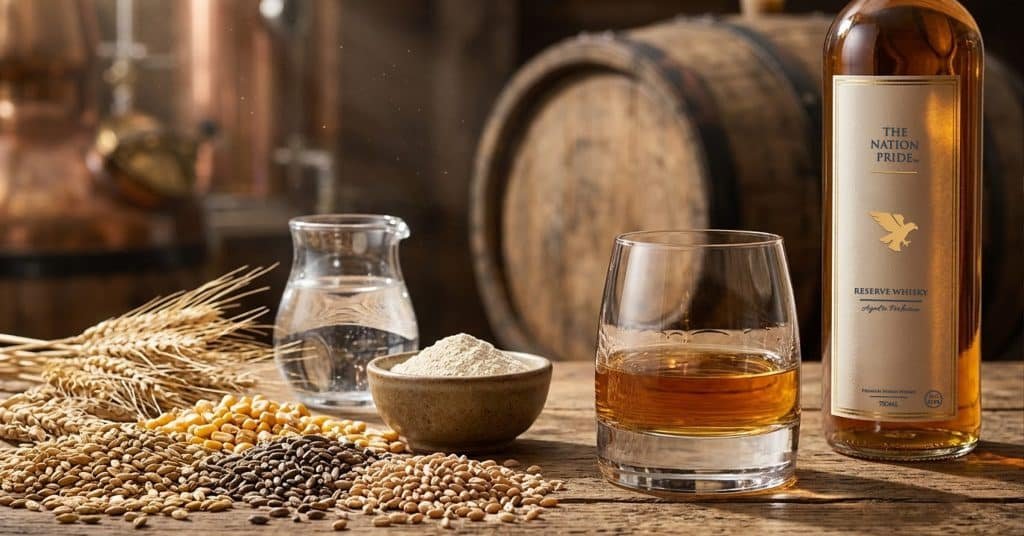
The manufacture of whisky cannot be reduced to the process of creating an alcoholic drink from cereals only. Whisky acquires its flavor and aroma due to various ingredients used and processes applied for its manufacture. The natural sweetness of corn and the rich grain character of malted barley, as well as a wide range of aromas that develop in the oak barrels during maturation, are among these ingredients.
Manufacturers use several components to produce whisky, including cereals, water, and yeast. Yet, depending on the type of whisky, as well as production practices and regulations, Whisky manufacturers can use certain types of cereals in different proportions.
Ingredients of the drink are never used separately. The way they interact with enzymes, fermentation conditions, copper equipment, and wooden barrels defines the specific flavor of whisky.
This guide provides information about ingredients of whisky, varieties of cereals, and their unique properties that are responsible for the specific character of the drink.
1. Ingredients of Whiskies
One of the key ingredients involved in the production of whiskies is the fermentation of grain mash. Manufacturers select suitable cereals, mix them with water, and add yeast to convert grain sugars into alcohol. Then distillation and aging of the beverage occur in accordance with the requirements of the specific type of whisky.
Ingredients are as follows:
- Barleys, corn, rye, and wheat contain starches needed to produce alcohol.
- Manufacturers use water during grain processing, mashing, and fermentation.
- Yeast—produces alcohol from sugars and adds taste to the whisky.
Oak barrels contribute colour, aroma, and additional flavor as whisky matures.
However, not all whiskies contain all four grains. In fact, one grain type or a combination of chosen grains may serve as a base for various types of whiskies.
Moreover, production rules stipulate what ingredients may be used. That is why knowing about raw materials is a good start for studying whiskies’ quality and flavor.
2. What Are the Main Ingredients in Whisky?
Each ingredient serves its own purpose in the production process. While grains supply starch, water helps extract sugars, and yeast performs the fermentation process. Also, there is one more element of complexity at the maturation stage.
Malted Barley for Whisky Production
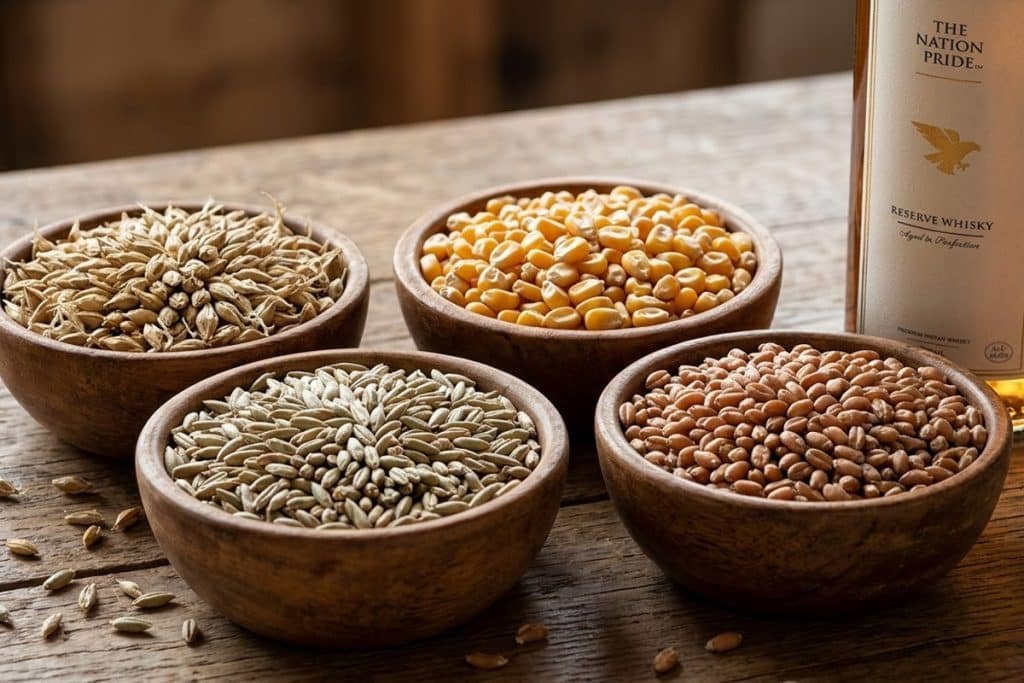
Malted barley plays an important role in whisky production, particularly when manufacturers produce single malt Scotch whisky. In the first step, manufacturers clean and soak the barley grains that further have to germinate.
In the process of germination, the enzymes develop in the grain, and they perform an important function of converting the starch into sugars in the mashing process.
Afterward, manufacturers dry the germinated grains using a kiln, and, in some cases, distillers use smoke from peat during this process.
Malted barley provides:
- The sweetness of the grain.
- Flavor notes of biscuit and cereals.
- Nutty flavors.
- Malty flavor.
- Fermentable sugars after mashing.
Therefore, malted barley is not only the base ingredient but also the element responsible for developing the flavor of certain types of whisky.
Corn as an Ingredient for Whisky Production
Corn is a key component used in the production of American whisky, especially in the case of bourbon. The naturally occurring high starch content in corn makes it possible for corn to be a valuable ingredient when producing fermentable sugar content.
The preparation of the corn mixture involves grinding of the corn and cooking of corn along with water.
Corn-based whisky may have flavor profiles that include:
- Flavor of sweet corn.
- Flavor impressions that are vanilla-like after maturation.
- Caramel flavors.
- Soft cereal flavor characteristics.
- Rounded flavor profile.
But the final flavor is not only determined by the presence of corn in the whisky. Other factors such as yeast used and other conditions involved affect the final outcome.
For bourbon, there should be 51% of corn present in the grain mixture.
The Contribution of Rye to the Flavor of Whisky
Another grain used by distillers to make whiskeys is rye. Rye may impart a flavour quite different from that produced using corn and barley.
Whiskeys made from rye often exhibit:
- Pepper flavour.
- Spicy features.
- Herbaceous flavour.
- Dry grain characteristics.
- An unique aroma profile.
Rye whiskey regulations require distillers to use at least 51% rye in the grain composition.
Also, there is starch in the rye which can be converted into fermentable sugars by distillers. Nevertheless, this grain needs a special approach to its handling during distillation process.
Wheat and Its Importance in Whisky Ingredients
Wheat can be considered yet another choice for whisky producers. In most cases, they use it in their recipes to achieve a milder and more balanced taste of cereals.
Depending on how producers make and mature it, wheat-based whiskey can develop qualities such as:
- Gentle cereal sweetness.
- Impressions of breadiness.
- Soft cereal tones.
- Relatively mild taste experience.
Wheat is also a source of starch for fermentation. Thus, it plays an important role both from the technological point of view and in terms of taste.
American wheated bourbons replace rye with wheat as the secondary ingredient.
Water: An Important Ingredient in the Production of Whisky
Whisky manufacturers use water as an ingredient throughout the production process. Even though there is no fermentable starch in water, it is very important in the preparation of grains, in extraction of sugars from the grains, and in diluting the whisky when required.
Use of water:
- For soaking of barley during malting,
- For cooking and milling of grains,
- For making conditions suitable for fermentation; and
- Dilution of whisky when required.
- Diluting the final whisky to desired strength before bottling.
Water quality is important during the production process. The properties of water may affect some processes.
However, it should be noted that the quality of water does not dictate the quality of whisky. Grain quality, fermentation, distillation and aging are equally important.
Yeast and Alcohol Production in Whisky
Yeast is a living organism that changes fermentable sugars into alcohol and carbon dioxide. Moreover, yeast forms a number of elements that determine the smell and taste of the resulting liquid.
Yeast strains are selected depending on the needs of producers. Different yeast strains may form various combinations of aromatic substances.
During fermentation, yeast can give:
- A fruity smell.
- Floral qualities.
- An estery smell.
- A bread-like impression.
- And other additional tastes.
The temperature of fermentation and its duration and condition of yeast are also important for the result.
Thus, yeast is not only an element that produces alcohol. It also plays an important part in forming the taste base that will be developed during distillation and ageing.
3. How Do Different Grains Affect Whisky Flavour?
Grain selection influences the basic character of whisky. However, no single grain guarantees a particular flavour because production conditions can change the way each ingredient expresses itself.
| Grain | Common flavour associations | Important role |
|---|---|---|
| Barley | Malty, cereal, biscuit-like | Traditional malt whisky production |
| Corn | Sweet, soft, cereal-like | Important in bourbon |
| Rye | Peppery, spicy, herbal | Defines rye whiskey styles |
| Wheat | Gentle, soft, bread-like | Creates a different grain balance |
For example, a corn-heavy mash bill can produce a different starting character from a rye-dominant recipe. Similarly, malted barley provides the enzymatic activity needed for traditional malt production.
Nevertheless, the final flavour develops through several additional factors. Fermentation creates flavour compounds, distillation influences which compounds enter the spirit, and maturation adds characteristics from the cask.
4. What is a whisky mash bill?
A mash bill combines the grains that distillers use to manufacture whiskey. Distillers have settled on certain proportions of grains depending on the needed type of product and legal provisions.
As an example, Bourbon regulations require distillers to include at least 51% corn in the mash bill. Rye, wheat, and malted barley may be included to create the mix of grains.
A rye whiskey mash bill should have not less than 51% of rye grains according to the US federal requirements.
The use of different mash bills affects:
- The sweetness of grains.
- The spiciness.
- Flavor of malt.
- Fermentation process.
- Flavor combination.
It is worth mentioning that even though the mash bill is a very important component of whiskey flavor, it cannot be considered as such because two distilleries having identical ratios of grains will still produce different whiskeys because of the equipment used, fermentation process, etc.
5. How Is Whisky Made From Grains?
Making whisky consists of a number of consecutive steps. The material is prepared for the subsequent step and gets converted from a raw grain to an aged whisky.
Grain Selection and Processing
The whisky production starts with selecting the appropriate types of cereal grains. In this case, the quality of grain, its starch content, moisture, and the type of whisky should be taken into account.
Then, manufacturers clean the grains to remove foreign material. They then grind or process them according to the production method.
Malt whiskies require malted barley, while the production of grain whiskey allows the use of unmalted grains, among others.
Malting: Germination of Barley for Whisky
Malting enables barley to germinate in a controlled manner. Natural enzymes form in this process to prepare the stored starch in grains for future conversion.
This process consists of generally three steps:
- Steeping: Immersion of barley in water to increase the moisture content.
- Germination: Sprouting of grains to activate enzymes.
- Kilning: Drying of germinated grains to inhibit further development.
Peat is used by some distilleries in the kilning process, and hence this process causes the formation of smoky character in the malt.
Mashing: Turning the Starch in Grains Into Sugar
The mashing process ensures that the processed grains are ready for fermentation. The grains are mixed with warm water inside specific equipment known as the mash tun.
Enzymes convert the starch in the grains into sugar during this process. This mixture is referred to as wort, which is rich in the sugars needed for fermentation.
This process is important since the temperature and the mixing process determine how well the enzymes function.
Finally, the producers separate the wort from the remaining solid grains.
Fermentation: Conversion of Sugars into Ethanol
Fermentation is a process that occurs after adding yeast to the mixture of sugars. Through fermentation, yeast converts sugars into ethanol and carbon dioxide.
It occurs in a specific type of equipment.
Variables affected by fermentation are:
- Production of alcohol.
- Flavor of fruit and flowers.
- Formation of esters.
- Characteristics of the wash produced.
- Base for the final flavor.
Fermentation time varies from one distillery to another. While some manufacturers like shorter fermentation times, others like longer times to achieve certain flavors.
At the end of fermentation, the process produces a grain-based, beer-like liquid without the bubbles and finishing characteristics of beer. This drink is known as the wash in the world of distilleries.
Distillation: Separation and Concentration of the Alcohol
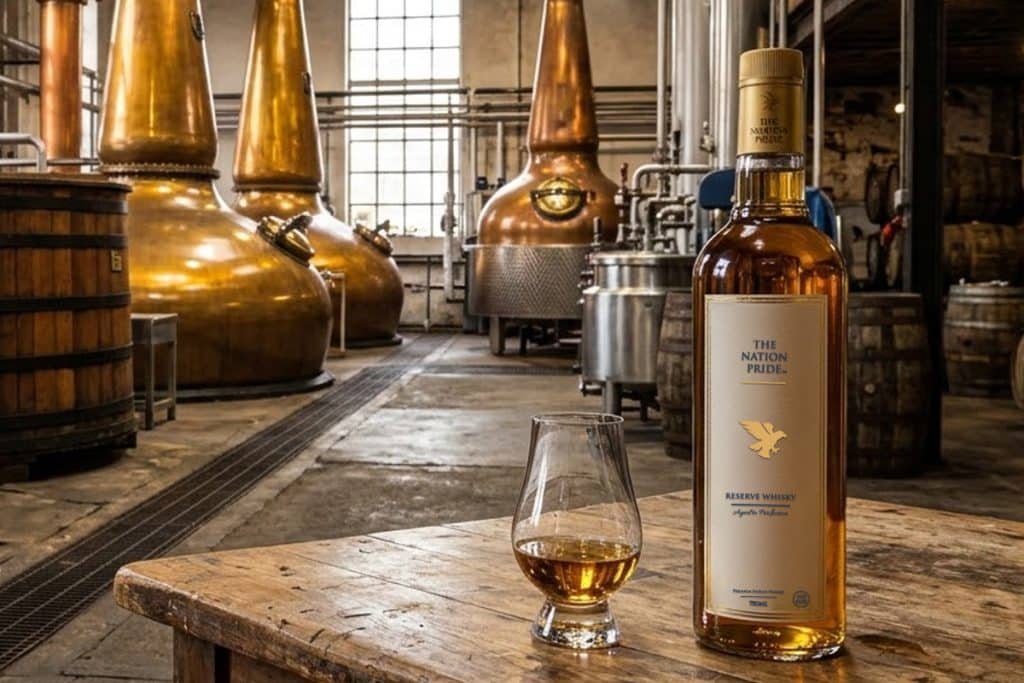
Distillers use the distillation process to separate alcohol from the other volatile components in the wash. Distillers heat the wash in a distillation apparatus to separate its alcohol and other components.
There are two main types of apparatus, such as
- Pot stills: Batch process apparatus usually linked with the production of malt whiskey.
- Column stills: Continuous process apparatus mainly employed in grain spirits and various whiskeys production.
Distillation affects the strength, body, and flavor of the spirit. Additionally, copper may play a role in dealing with some undesirable sulfur compounds.
In addition, distillation allows distillers to make important choices on what part of the distillate to use.
Maturation: Process of Developing Flavor for Whisky Using Oak Casks
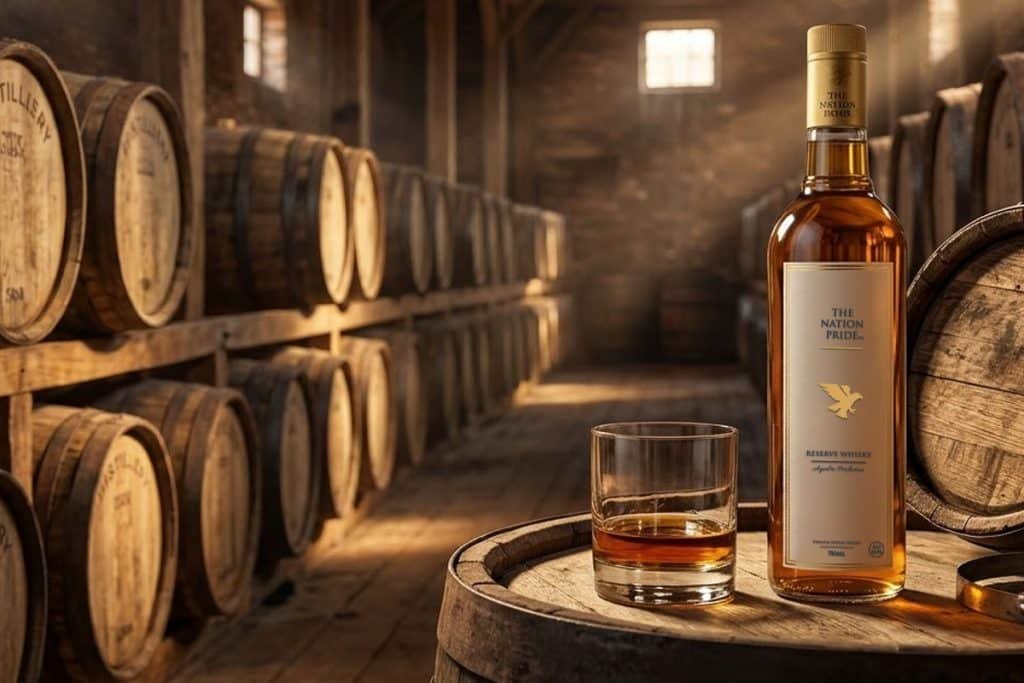
This is where the distilled spirit develops its flavor within the wooden cask. The oak cask is an important component because it provides color, flavors and aroma.
Processes which take place during the maturing period include:
- Extraction: The spirit takes out elements from the wooden cask.
- Oxidation: Oxygen causes changes in the nature of the spirit.
- Evaporation: Evaporation takes place of some liquids in the cask.
Interaction: There is interaction between the compounds of the spirit and the wood to develop new flavors.
The oak cask can provide flavor and aroma of vanilla, caramel, spices and toast wood among others.
However, there are various factors that determine the final outcome such as cask history, previous contents, wood preparation and the duration of maturation.
Blending and Bottling the Matured Whisky
Some whisky makers blend matured whiskies to obtain a constant flavor. This step is known as blending.
The blenders assess certain aspects like smell, taste, mouthfeel and balance of the spirit before choosing appropriate elements.
Then the manufacturers filter and dilute the whisky with water depending on the regulation for the specific product.
Finally, manufacturers bottle the whisky and add the appropriate labels.
6. How Do Whisky Ingredients Influence Aroma and Taste?
Whisky flavour develops through the combined effects of raw materials and production methods. Therefore, identifying a single ingredient as the source of a particular aroma can oversimplify the process.
The following table explains some common flavour associations:
| Ingredient or production factor | Possible flavour characteristics |
|---|---|
| Malted barley | Malt, biscuit and cereal |
| Corn | Sweet grain and soft cereal |
| Rye | Pepper, spice and herbal notes |
| Wheat | Gentle grain and bread-like notes |
| Yeast activity | Fruity and floral compounds |
| Peat smoke | Smoke and earthy characteristics |
| Oak maturation | Vanilla, spice, wood and caramel |
For instance, a whisky may contain corn and still develop prominent vanilla notes because oak maturation contributes significantly to its aroma.
Similarly, fruity flavours often originate partly from fermentation compounds rather than the grains themselves.
This is why experienced tasters examine the complete production process instead of judging a whisky solely by its grain recipe.
7. Are Ingredients of Whisky Different for Every Type of Whisky?
Yes. Since each whisky type has its own tradition and rules of production, then different grains and methods are used.
Ingredients of Scotch Whisky
Production of scotch whisky is regulated by specific rules for Scotch whisky, which apply in Scotland.
Ingredients for single malt Scotch include water and malted barley, as well as production conditions including distillation at a single distillery in Scotland in pot stills.
Other cereals, apart from malted barley, may be used in the production of grain Scotch, while blended Scotch contains both malt Scotch and grain Scotch whiskies.
The period of maturation should last at least three years in oak barrels in Scotland.
Ingredients in Irish Whiskey
The process of Irish whiskey is based on the relevant Irish whiskey technical specifications.
The manufacturer may choose malted barley, unmalted barley, and other permitted grains depending on the type of product.
For instance, single pot still Irish whiskey is made of a blend of malted and unmalted barley, and other permitted grains in certain proportions.
Thus, the manufacturing technique and the grain used differ depending on the particular kind of Irish whiskey.
Ingredients in American Bourbon
According to the United States federal regulations, bourbon contains a certain quantity of grains.
Namely, the recipe of bourbon should contain no less than 51% of corn. The rest of the grains include rye, wheat, malted barley, etc.
Thus, the ingredients and production conditions of the spirit distinguish it from the rest of American whiskeys.
Ingredients in Rye Whiskey
American rye whiskey includes not less than 51% of rye grains.
The manufacturer may use corn, malted barley, and other permitted ingredients in combination with rye.
Thus, rye grains form the base of the particular spirit, while fermentation and maturation give aroma and flavor to it.
Ingredients used in Indian Whisky
There are multiple product categories and production methods used in the production of Indian whiskies. These include the use of malted barley, cereals, and even alternative alcoholic ingredients, depending on the specific product category and regulations.
Consumers should not, therefore, expect all Indian whiskies to be made using the same formula and process.
Ingredients used in the production process depend on the specific category of Indian whisky.
8. Is Whisky Quality Determined Solely by Its Ingredients?
No. The ingredients constitute the base, but manufacturing choices will help manufacturers utilize the ingredients efficiently for the production of the finished product.
A number of issues determine the quality of the final product.
Quality of the grain: High-quality grains give the needed starch and also determine the taste character of the spirit.
Water usage: Proper water quality and conditions for production will ensure consistent manufacturing.
Choice of yeast: Different yeasts may yield different aromatic substances.
Fermentation: The temperature and time of fermentation will determine alcohol content and flavor formation.
Distillation methods: Distillation will also determine the character of the final spirit due to the type of still used, the amount of copper contact and distillation process.
Selection of cask: Selection of oak type, whether used before and also the conditioning of wood will determine the flavors of the spirit.
Therefore, a good quality grain does not necessarily mean that the whisky produced is exceptional.
9. What Is the Difference Between Malt Whisky and Grain Whisky?
Malt whisky and grain whisky differ mainly in their grain composition and production methods.
| Feature | Malt whisky | Grain whisky |
|---|---|---|
| Main grain | Malted barley | Other permitted cereals, depending on category |
| Production | Commonly uses pot stills in Scotch single malt production | Often uses column stills |
| Flavour | Can display malty and cereal characteristics | Can show lighter or different grain characteristics |
| Common use | Single malt and blended malt | Grain whisky and blended Scotch |
However, the exact differences depend on the whisky tradition and its legal category.
For example, single malt Scotch must use malted barley and pot still distillation. In contrast, Scotch grain whisky can include other permitted cereals and different distillation equipment.
10. Can Whisky Be Made Without Barley?
Yes. There are some whiskies that don’t need barley at all; they have different rules.
For example, bourbon whiskey in America uses mainly corn and also uses rye or wheat as a second grain. In the same manner, American rye whiskey uses rye as the first grain.
On the contrary, when it comes to traditional single malt Scotch whisky, it is advisable to use barley malt.
Thus, barley is an essential component in some kinds of whiskies but not all.
11. Can Ageing Influence the Flavor of Whisky?
Yes, it is, since aging makes whisky have more flavors owing to the time it spends in wooden barrels.
It is because of the chemical reaction that occurs between whisky and wooden barrels. Some of the flavors include vanilla, spices, caramel, wood, and many others.
But age is not always equal to quality when it comes to whisky.
The following considerations affect the aging process:
Quality of barrel used and its previous use.
- Kind of oak used.
- Condition of the warehouse where it is kept.
- Climate conditions.
- Character of the initial spirit.
- Period of aging.
At times, over-aging can result in an imbalanced flavor in the spirit.
A properly aged young whisky can thus be as good as a mature one.
12. What is the Reason Behind Using Different Oak Casks by Whisky Makers?
The oak cask adds certain flavours during the ageing process. The producers choose casks based on the desired taste in the whisky.
Some of the commonly used barrels are listed below:
American oak barrels: These barrels may provide flavors like vanilla, coconut, caramel, and sweet wood.
European oak barrels: Based on their prior use and preparation, they can add flavors like dried fruits, spices, and rich wood.
Sherry barrels: Dried fruits, nutty and sweet flavors may be provided by these barrels.
Bourbon barrels: Prior to being used for maturation, they may add flavors like vanilla, caramel, and oak.
Choice of barrel is an important aspect of making whisky as the same spirit, when put in different barrels of wood, turns out differently.
13. How Can You Detect Whisky Components through Its Taste?
Knowing about the components of the whisky will help you get even more information during your tasting. Nevertheless, detecting the grain of one whisky through its taste might be a challenging task because of the production process.
So, here is what you need to do:
- Pay attention to the color of the whisky.
- Smell the whisky and find the aroma of cereals, fruits, spices, or wood.
- Drink a little whisky and let the liquid slide across your tongue.
- Pay attention to the body of the whisky. It may be light, creamy, oily, or full-bodied.
- Identify the flavors that stay in your mouth after you swallow the whisky.
- Another method is to try two kinds of whisky to see the difference between their flavors.
You can add a bit of water to feel more comfortable during tasting.
14. Myth Regarding Whisky Components
There are a number of myths that may lead to misunderstandings regarding whisky production. Here are some of the most common myths followed by their reality.
Myth 1: All whiskies contain barley.
Reality: There are different types of whiskies which are made from different grain combinations. Some varieties of American whiskies for instance use either corn or rye as the base grain.
Myth 2: Higher priced grains create a higher quality whisky.
Reality: Though grains are a significant factor, other factors also play a role in determining the quality of whisky.
Myth 3: Grains add colour to all whiskies.
Reality: The coloration of whiskies aged in oak is due to the oak maturation process.
Myth #4: Whisky improves with age.
Reality: Age does not mean quality. The state of the barrel and maturation of the spirit plays an extremely important part here.
Myth #5: Corn gives whisky sweetness.
Reality: Corn provides a sweet grain base; however the taste changes completely after distillation and aging processes.
Myth #6: Water only reduces the alcohol level.
Reality: Water helps in the mashing and fermentation process. Small amounts of water in the tasting process have a big effect on the aroma and taste.
15. Frequently Asked Questions About What Whisky Is Made From
Question 1: What components are used in the manufacture of whisky?
Almost all kinds of whisky use cereals like barley, corn, rye, and wheat. The cereals are combined with water and converted to alcohol through fermentation by yeast. The whisky is then distilled and aged as per the requirement of the category of the whisky.
Question 2: Which grain is mostly used in the making of whisky?
Malted barley serves as an important ingredient in certain traditional varieties, while producers also use maize, rye, and wheat in other styles. Each grain contributes different characteristics to the final spirit, influencing its aroma, flavour, and overall texture. The choice of raw materials depends on the production method and the specific category being produced.
Question 3: Is malting of barley used in all types of whiskies?
No. Different whiskies require different ingredients. For instance, corn is the most common grain in American bourbon, while single malt Scotch is malted barley only.
Q4. Why do whiskies have water in their content?
Water assists manufacturers in preparing the cereals, extraction of fermentable sugars, production of the whisky and adjusting the alcohol content if allowed.
Q5. What is the role of yeast in the whisky making process?
Yeast helps to produce alcohol from fermentable sugar, and at the same time, it produces flavors that help to give the spirit its taste and smell.
Q6. Which one is sweeter, corn whisky or barley whisky?
Corn whisky might be sweeter in terms of the grain flavor compared to some barley whiskies. However, the taste will depend on all other factors such as yeast, fermentation and maturation.
Q7. Can there be artificial additives in the whisky?
The traditional way to make whisky is based on grains, water, yeast and maturation. Yet, the list of ingredients and additives differs depending on the type of the whisky and country of production.
Q8. How is the brown color of whisky obtained?
Oak casks provide the natural coloring during the maturation process. It depends on the type of wood, the condition of the cask, and the maturation conditions. In certain types of whisky caramel color is allowed.
Q9. Is it possible to produce whisky from wheat?
Yes, wheat is an ingredient in some formulas for whisky, even American wheat bourbons. The grain provides the starch and grain character to the blend.
Q10. Is there gluten in whisky?
There may be gluten in the cereal grains used in making the whisky, but during distillation, all the proteins are removed from the end product.
Conclusion: What Ingredients Compose Whisky
To understand whisky, one needs to consider more than just its ingredients. Barley, corn, rye, wheat, water, and yeast all play significant roles in the production process. However, their contribution depends on the fermentation, distillation, and maturation methods that producers follow.
From grain selection to the interaction between the spirit and oak barrels, every stage of production influences the final character of whisky.
Different whisky varieties also reflect distinct traditions, ingredients, and production methods. Each type develops its own character through these variations.
Understanding these ingredients helps whisky lovers appreciate what makes each variety unique. Moreover, exploring the production process helps consumers recognise the differences in aroma, flavour, and texture. It also provides a better understanding of how manufacturers create distinctive whisky profiles.
At Grihy Beverages, understanding production methods and consumer preferences remains essential to gaining insight into the Indian whisky and beverage industry.
Furthermore, factors such as ageing conditions, barrel selection, and blending techniques contribute to the overall character of the spirit. Together, these elements help explain the diversity of whisky styles available across different markets.